Tuesday, May 24, 2011

Why Can't We Do It?


Over the weekend I visited a friend in Bangkok. It's exotic and interesting, but that isn't what I left there thinking about. My real take-away is about transportation. I have two primary points of reference for traffic - one is Seattle and the other is Saigon. Both are traffic nightmares; Bangkok is not.

Bangkok's population is officially listed as 9,100,000, about the same size as Saigon and five times the population of the whole of King County, Seattle's home. The streets of Bangkok are wide and traffic flows normally for a major metropolis. At rush hour things slow down but at other times they flow fairly smoothly. Saigon's 5,000,000 motorbikes make the traffic chaotic, unpredictable and sometimes outright dangerous. Motorbikes share the streets and sidewalks with bicycles, cars, pedestrians, cyclos, and pushcarts. There is some kind of protocol, but it's difficult to figure out. In Bangkok there are only a few bikes and motorbikes. What is the difference?

Here it is: Bangkok has a mass transportation system. That's the difference. The BTS Skytrain and the MRT Underground move huge numbers of people swiftly through the city in comfortable air-conditioned cars at reasonable prices. They also leave the streets free for automobile and bus traffic. Why is it that Thailand, ranked #30 in the world in GDP can move people more efficiently than #1 ranked United States? I don't know the answer, but I think we deserve one.

In 1953 Seattle built a double-decked elevated roadway through downtown, and in 1963 the Evergreen Point floating bridge was built to connect Seattle to the eastern suburbs. Now, 50 years later both of them are falling apart and need to be replaced and there is no mass transit anywhere (Light rail is a very short joke). Seattle is infamous for its "process." Everyone must be heard and heard and heard, but nothing gets done. Seattle has been arguing over both the viaduct and the bridge for more than 10 years. Finally, last year a "consensus" was arrived at and we decided to build a tunnel to replace the crumbling old elevated eyesore through downtown. It was a struggle but the tunnel won out and it was agreed that the solution would also create a beautiful San Francisco-like waterfront that would attract locals and tourists alike as well as move traffic efficiently. But, now the "process" is grinding us down again and someone has collected the required number of signatures to bring the matter to another vote on the ballot in 2011. For some reason it seems more important to stop doing things in Seattle than to do them.

Why can't we have a beautiful waterfront, a functional bridge system and, yes, a mass transit system too? If #30 can do it, why can't #1?

Monday, May 2, 2011

It Was A Big Weekend


Did you get invited to the wedding on Friday? It was a big day for the bride and groom, but we had a great time too. We weren't actually able to get to Westminster Abbey, but we did get to the Snap Cafe in District Two, Ho Chi Minh City. There are a enough British expats working here that the British Business Group Vietnam (BBGV) decided to celebrate the event locally. The Snap was a great choice - no clotted cream and scones but a big open space with a playground for the kids and lots of beer and popcorn.

Attendees were encouraged to dress for the wedding, but with 95F temperatures and a thatched roof hut for the venue there were only a few takers. There was one gent in a morning coat and a few women with large brimmed hats and hankies to mop their brows or dab their tears of joy. Most of us arrived before the TV coverage began and the atmosphere was very festive. There were two big screens (actually sheets hung from the posts and thatch) and bench seating. As opposed to the Abbey, this crowd was up and mingling and the kids were hanging from the monkey bars.

We settled down on a couch in the smaller of the two viewing venues and immediately made friends with the two women on the couch beside us. One of the women was a handsome black woman from Malaysia who came to Vietnam with her husband 20 years ago, divorced him and has been working ever since as a teacher in one of the independent schools. Her friend was a stylish upscale blond of a certain age who was born in North Borneo, raised in Hong Kong and educated in the UK. She's the "girlfriend" of a Frenchman who runs a venture capital firm. As Kate and Will drove to the Abbey and walked down the aisle we introduced ourselves and did running commentary on the crowd, the car, the horses, the dress, the uniforms, the royals, the foliage in the nave, and the voice of the bishop. In the process we learned that North Borneo lady's brother is a world class sailor who has just opened a sailing school in MuiNe and the Malaysian woman has strong opinions about the death of Princess Diana. The incredibly wonderful thing about being an expat in Saigon is that you meet an endless chain of interesting people and these two were no exception.

As I sat down to write about the wedding and our new friends I learned that a Special Forces team raided a compound in Pakistan and killed Osama Bin Laden. It was a very big weekend. I wonder if Donald Trump will find a way to "be extremely proud" of his role in either event or perhaps question the reality of them.

Tuesday, April 26, 2011

Rosie is a Goddess


This is Rosie. She is a goddess. She lives in a township,called Khayalitsha in Cape Town, South Africa. Khayalitsha is a legacy of the Group Areas Act passed by the white SA government in 1950. Khayalitsha itself was not established until after the abolition of the pass laws that required blacks to have permission to travel within the country. During that terrible time male laborers came to Johannesburg and Cape Town for work, and the townships were established to house them. Soweto, in Johannesburg, with 1.3 million residents is probably the most infamous of these slums. Khayalitscha is the largest one in Cape Town and home to roughly 500,000. With the end of the pass laws and apartheid women started coming to the townships and families grew up in them.

About 5 years ago Rosie decided to do something for the poorest of the poor kids in her township. She enlisted the help of friends and neighbors who brought her things like cereal and potatoes and she started a kitchen to help feed the kids. She's famous now. Everybody knows Rosie and the tiny room she calls Rosie's Diner. Every day she feeds 185 kids breakfast before they go to school and dinner when they come home. It's simple fare - porridge for breakfast and beans, potatoes or rice for dinner, but these kids who are AIDS orphans, abandoned or from poverty get the nutrition they need to carry on.

I met Rosie through Alan Petersen, a local guide who helps support Rosie's operation. Alan had us take a big sacks of potatoes and onions when we stopped by to see her. Alan has organized a group of independent guides to help Rosie keep things going. Rosie's reputation has spread and a couple of years ago Habitat for Humanity came and built a house for her. She, like many, is a single Mom and the house is really her dining room. Her old house burned down a few years ago and she is badly scarred from the fire, but she never stopped smiling and saying thank you the whole time we were with her.

She and her helpers cook in a tiny 6'x 6' kitchen off to the side of the house. It smelled great when we were there - onion and potatoes cooking in huge stainless pots. CNN has a project called CNN Heroes to celebrate selfless individuals who are making a difference in their communities. I'm going to do what I can to nominate Rosie in the next round of CNN Heroes. She truly deserves the title.

Thursday, April 14, 2011

Which One Is The Real South Africa?


South Africa is beautiful, ugly, friendly, dangerous, sophisticated, primitive, and very, very complicated. Yesterday we visited two black townships, the District Six Museum, the penguins on Boulders Beach and the Cape Point lighthouse at the southernmost point on the African continent.

We have met people who had to leave the country because of their activities under apartheid and people who think things were better then. We have met blacks, coloreds, and whites - distinctions that would be racist in the US but are convenient and acceptable labels here. We visited astonishingly beautiful wineries set in the fairytale landscapes of Stellenbosch and Franzhoek, and spent time with a former miner who makes gorgeous flowers out of discarded Coke cans. We have seen beautiful blonds carrying their yoga mats into an upscale yoga studio and looked down on the shacks of Khayalitsha where 50,000 blacks live in squalid galvanized tin huts (above). We ate in one of the world's best restaurants and took a bag of potatoes and onions to Rosie, a woman who feeds breakfast and dinner to 185 orphaned township children before and after school. We've seen lion and cheetah eating their kudu and young giraffe kills, and we've noticed that almost every middle class dwelling in Cape Town is like a fortress with locks and bars on all the doors and windows. Wherever we have gone - on the street, in the townships, at the wineries, or in the open markets - we have been greeted by friendly, welcoming, generous, and seemingly happy people. What is the real South Africa?

At this point I would say all these people, situations and conditions are the real South Africa. It's a fascinating place but dense and complicated. It's impossible to decode the mystery in two short weeks. With all that is happening in Africa today it wouldn't be surprising to see the country reach a tipping point in the not too distant future. Mandela is in his 90s, Tutu is 80. The current President has 5 wives and no one we've met thinks he represents the best of South Africa. It is a country tucked away as far from America as any in the world. It's been a privilege to spend time here. I wish it were easier and cheaper to get here. We would definitely do it again.

Saturday, March 26, 2011

Everyone Has a Story

No one is here in Saigon by accident. Everyone has a story, and the most interesting question you can ask when you meet someone new is "How did you end up here?" Some of them came because they work for multinational companies and wanted to work in a more exotic part of the world. Some of us came to work for international organizations that are helping to rebuild the country's infrastructure and help the most disadvantaged people. Others have come back to the country they or their family left for political or survival reasons. Families left because they worked for Americans during the war and faced a future in re-education camps or on collective farms after the war. Some left because conditions were so hard and poverty so epidemic that it was better to chance it at sea in a rickety boat than stay in the family home. Some came as part of a travel adventure and decided to stay. Some have come back to see where they fought or where their family once lived. Some are just passing through. Everyone has a story.

Last week I met three new people - The first was John Riordan. My friend Brett Krause is the CEO of Citibank in Vietnam. I had lunch with Brett on Thursday and he told me that the man who shut down the Citi office and evacuated the employees as Saigon was falling to the NVA in 1975 was in town. After lunch he called and asked if I would like to meet him. He was looking for a good bowl of French onion soup and we agreed to meet at a local French cafe. For the next hour John recounted this harrowing story about the fall of Saigon, the mixed messages coming out of the Embassy, the coded telexes coming from NY, the midnight taxi rides and clandestine meetings, burning documents in a window well outside the bank's second floor office and the eventual evacuation of 105 of the bank's employees and their families aboard a chartered Pan Am jet. I can't do the story justice, but it is another example of an ordinary person who accomplished a heroic service under enormous pressure and gave a new life to his friends and employees. Many of the evacuees ended up in New Jersey working for Citbank in New York City.

The second person I met is Au Quang Hien. Hien was one of 10 brothers, the son's of a prosperous family in South Vietnam. At the end of the war, Hien's family home was confiscated and the family sent to a government farm/camp in Binh Duong. There was no food and 12 mouths to feed. He told us the story of sharing one egg with his 9 brothers. After some time they escaped the camp, and the 12 of them walked to the Delta village where his mother's family was located. They wanted to leave the country and eventually they received permission from the government to leave for Hong Kong because of a family member's connection there. From Hong Kong the family went to the UK where Hien and his brothers grew up and went to school. Hien revisited Vietnam sometime in the '90s and after a few years of working for a business in the UK he returned to Vietnam. He's now the GM of a multinational insurance company, married to a Vietnamese woman and has two beautiful children who are bilingual. He's made a life here and I'm sure he'll stay. The other brothers are also successful and scattered around the world - the Vietnamese diaspora.

I don't know the name of the third person. I met him because my friend, Marie Brandby, needed my help to reach him. Marie is a freelance journalist who is doing a stint as the Communications Director of Semester at Sea. The ship stopped here for 4 days over the weekend, and Marie wanted to pursue a lead she had on a story. She had a name and phone number but needed a translator. My friend and office manager, Nga, agreed to help and the call was made. I'll tell you the story when I get it from Marie, but the story is about a young boy and his sister. The boy is now 41 years old, his sister a year or two younger. They are survivors of the My Lai massacre. Yes there were some survivors and they remind us that these unfathomable atrocities are fresh enough to meet face to face. I actually looked them in the eye and shook their hands. The sister came to the interview with her 16 year old daughter who wants to be a flight attendant. Everyone has a story, but the stories you hear in Saigon can rip your heart out. A My Lai survivor with a flight attendant daughter. The Great Mandala - the wheel of life.

Saturday, March 12, 2011

We All Have Days Like This...

It's been almost a month since my last post. We're back in Saigon and into our rituals again. Today we sat, as we always do on Sunday, on the terrace of the Coffee Bean and Tea Leaf outlet across from the famous Notre Dame Cathedral watching the panorama. It's always a visual feast - upscale locals sipping lattes and fiddling with their smartphones, overweight German and American tourists in black socks and Birkenstocks, tall slim girls in sheath dresses with 6 inch heels looking as if they had just come off the runways of Paris, brides and grooms in rented tuxes and dresses being stylishly photographed in the square, hoards of shoe shine boys and lottery ticket sellers, old white guys with young Vietnamese girls, the whole menu of Sunday sights.

This is the leisurely side of the upscale expatriate life. But, there are many sides. If everything goes as planned, life is good. But there is always an underlying anxiety when you are living in a country where you don't speak the language fluently. If there is a problem you always seem to need the help of a local friend to explain and translate. Skilled professionals feel vulnerable, dependent, and helpless. A friend of mine had a meltdown last week when his motorbike wouldn't start. He's been here for 7 years with a good job as the vice-principal of an international school. He lives with a Vietnamese friend and gets along just fine until something goes wrong. In this case his bike quit in the basement of a hotel parking garage. He pushed it up two long ramps to get to the street and knew enough to find one of the motorbike repairmen that squat on corners throughout the city. Bad news. The repair guy couldn't fix it. So he left the bike and caught a taxi to a shop where he could rent a bike until his got fixed. Next problem. Rental bikes come without gas, so he pushed the rental a few blocks to the nearest gas station. Next problem. The seat wouldn't unlatch and give him access to the gas cap. Next problem. He tried to call the rental shop but the two numbers on the rental contract were out of service. At this point, he called his roommate who had to come pick him up and translate about all the mishaps with both the repairman and the rental guys. By now he's late for work and, even though he's been there 7 years he won't get paid for the day because even a few minutes late will cost him a day's pay. He loves it here, but the only thing he could say was "Why am I living in a place where I can't speak the language and am like a helpless child when things like this happen?" That same day, Marilynn's phone stopped working, her computer gave her fits, the kitchen stove malfunctioned, and our DVD player failed. We needed lots of help and third party intervention. Some days are better than others, but let it be noted that we have cell phones, computers, stoves and DVD players. The people around us live without hot water, electricity or enough food to sustain a normal life. The expat life is good but it has its challenges. Hold your breath and walk slowly and steadily across the street. Those thousands of motorbikes really will go around you.

Sunday, January 16, 2011

Close to shopping, good parking, open air...


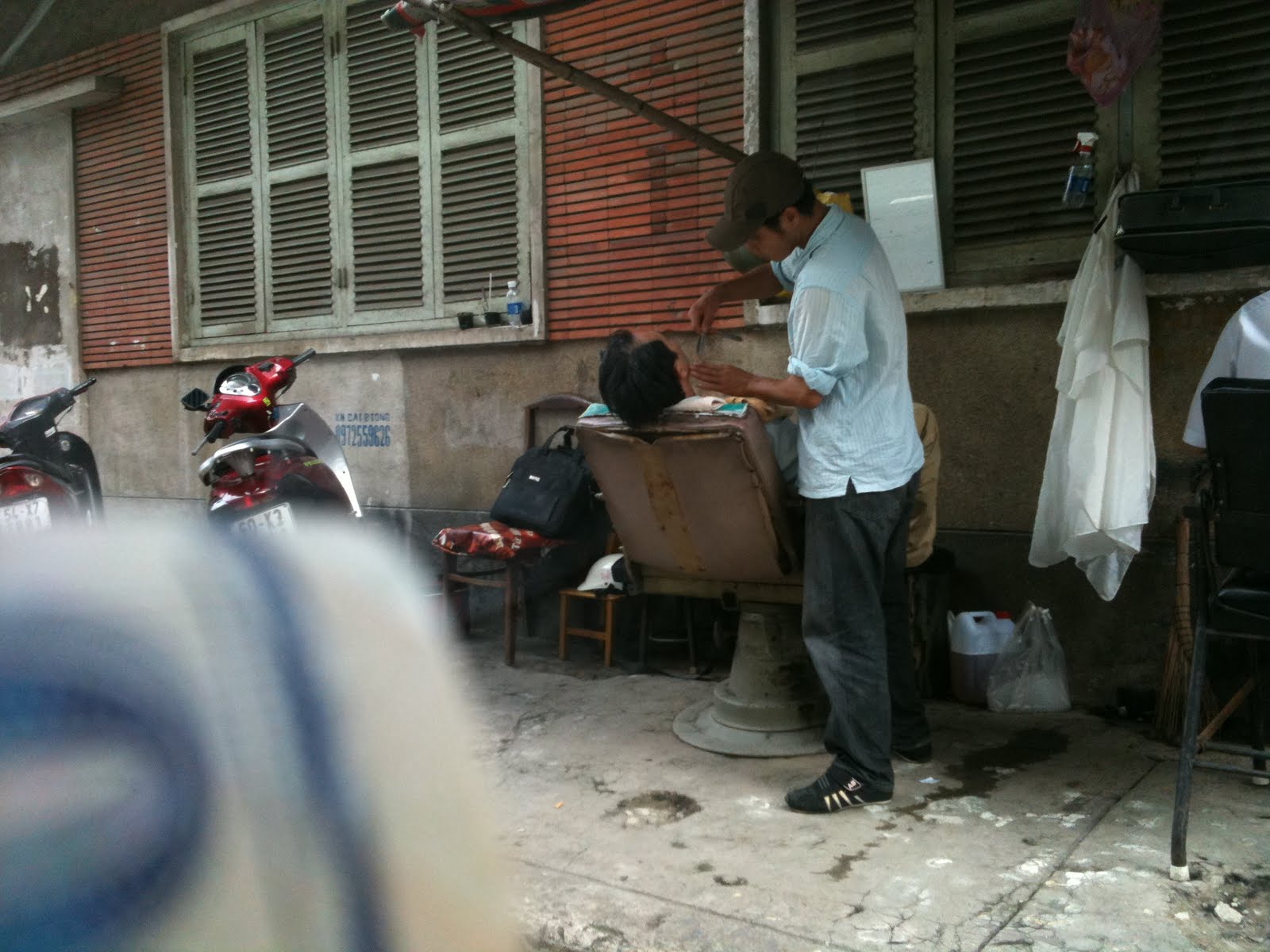
This is the neighborhood barber, just a few doors down from my apartment. He's very friendly and keeps signalling that he'd like to have my business - especially since I have a shaved head and he does a lot of close work with a straight razor. I've had to pass on the opportunity. It's a little out of my comfort zone given the fact that he has no hot or running water and uses the same razor and towel for all his customers. He does keep a jug close by, but I'm not sure if it's to take care of his thirst or to clean the blade between shaves. He seems to be busy, especially in the afternoon when his awning provides a little shade and relief from the searing Saigon heat. This is literally just another roadside attraction. Welcome to the neighborhood.